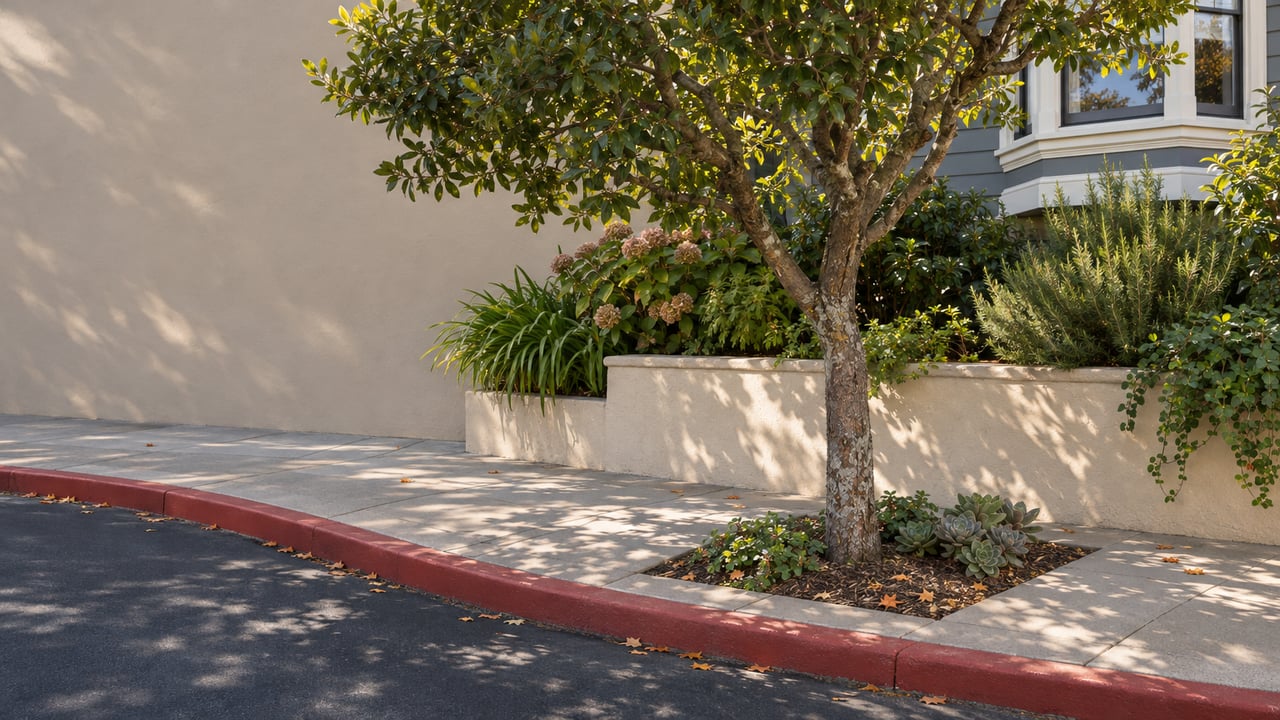
What do you do with 20 feet of curb you can no longer park on? Glen Park answered that question with grant applications. By this summer the neighborhood had $70,000 from three Avenue Greenlight grants for murals, planters, banners and a new welcome sign. What happens next depends on how fast city agencies can measure, review and approve each project. The first permanent pieces are aimed at spring 2027, and the design choices behind them are being made now.
Where the empty corners came from
The spaces come from California's daylighting law. AB 413 bans stopping, standing or parking within 20 feet of the approach side of a crosswalk, marked or unmarked, or within 15 feet where there is a curb extension. The governor signed it on October 10, 2023. According to the SFMTA's daylighting page, the law took effect January 1, 2025, and as of May 2026 the agency had daylighted 65% of the city's intersections. Under the SFMTA's February 2025 enforcement plan, drivers get only zero-cost warnings at unmarked gray curbs until the curb is painted red.
Arlington Street already has daylighting zones, and organizers there want to use them. In June 2026 the SFMTA started its Community Corners program, which lets neighborhood groups put that strip to use.
What the city asks of a group that wants a corner
Community Corners is a two-year pilot. Nonprofits, community benefit districts, merchant associations and neighborhood associations can apply to pay for and maintain murals, planters or both inside painted safety zones. The application portal is open. Every applicant takes on these obligations:
- A $50 registration fee.
- A maintenance agreement, so the group, not the city, keeps the corner up.
- Insurance for any planters.
- San Francisco Arts Commission approval before a mural is painted on the street.
The corner itself also has to qualify. The SFMTA limits the program mostly to low-traffic approaches controlled by stop signs, and the corner must already have 20 feet of red curb plus a painted safety zone. On Slow Streets, the agency's program presentation says the SFMTA may paint extra safety zones for murals and planters, with residents and city staff choosing the spots together. That provision matters most on Arlington Street.
This post is general information about city programs and state law, not legal advice. If you have a specific question about parking rules or a group application, check with the SFMTA or the right professional.
Three grants, one waiting list
Avenue Greenlight describes itself as a nonprofit that gives grants to local leaders for projects like murals, lighting, cleaning and urban greening. It is funded by donors, and community groups apply with a plan. The San Francisco Standard reported that Chris Larsen founded it in 2021. Glen Park's three awards were posted on Avenue Greenlight's news page on July 8, 2026.
| Project | Grant | Who is behind it | Where it stands |
|---|---|---|---|
| Slow Arlington corner murals and planters | $25,000 | Glen Park Association; organizer John Francis; artist Dahlia Gustafson | SFMTA was drawing paintable dimensions as of October 20 |
| Pono patio mosaic and welcome sign | $25,000 | Glen Park Beautiful; Renee Berger, Libby Reder, Beth O'Leary; artist Dana Albany | Both aimed at spring 2027 |
| Mission Street banners | $20,000 | Sophie Constantinou for College Hill Neighborhood Association; EvolvedSF | Grant awarded |
Arlington: the one with a deadline
The Arlington grant pays for murals and more permanent planters on the daylighted corners of the Arlington Slow Street. The idea is to make those spaces friendlier for people on foot and on bikes without changing how traffic moves. The Slow Arlington page says the money has to be spent within one year. In the meantime, organizers planned temporary planters in the existing daylighted zones to "claim the space" until permanent Community Corners installations go in.
Design is underway. At the Glen Park Association's October 20 quarterly meeting, members heard that the SFMTA was still measuring what can be painted. Dahlia Gustafson, who grew up on Arlington, will work neighbors' feedback into her designs for the corners. The money arrived in July, and the city's measurements are the step everything else waits on. Within that one-year window, the project still has to wrap up design and get Arts Commission approval for the murals before any paint goes down.
Organizers are thinking further ahead too. Their longer-term plans include permanent concrete bulb-outs with trees or shrubs, and a chain of rain gardens and bioswales along the Bernal Cut to keep runoff out of the Islais Creek watershed. They are working on these with the Glen Park Association and Green SF Now.
Diamond Street: a mosaic and a sign
Glen Park Beautiful's grant pays for two projects downtown. The first is a mosaic mural on the fence at the back of the patio next to 2860 Diamond Street. The group credits the private owners of 2852–2860 Diamond for making the site available. Pono Boutique, the facial, brow and waxing studio, sits next to that courtyard. Dana Albany is the artist, and she was scheduled to present a first draft at the Glen Park library on October 21. The group is targeting spring 2027 for installation.
The second is a planned restoration and refresh of the "Welcome to Glen Park" sign at Bosworth and Diamond, which is also on track for spring 2027. According to the Association's summer meeting summary, the same grant could later help pay for pop-up events on the Pono patio.
Mission Street: the gateway
The third grant goes to banners along Mission Street toward Bosworth, which the Association calls the gateway to Glen Park. Screen printers EvolvedSF and Keikos Coffee Shop, both on the 3900 block of Mission, have joined longtime businesses there in sprucing up the corridor. Thalia Leon and Fernando Ramirez of EvolvedSF are working with College Hill Neighborhood Association on the screenprinting and design.
The underpass and the ramps are on the same schedule
Two more nearby street projects are moving through design at the same time. Bernal Cut Project has proposed an Islais Creek Watershed Storytelling mural for the I-280 underpass, an educational piece that would complement two murals proposed for the other side. The Glen Park Association has written a letter supporting it.
The SFMTA's Livable Streets team, meanwhile, has proposed quick-build changes at the Monterey and Bosworth freeway ramps. They include a crosswalk across Bosworth at the foot of Arlington, a flashing beacon at the crosswalk across the Bosworth I-280 on-ramp, and a protected bike lane between Monterey Boulevard and San Jose Avenue. The agency is also looking at better bike routes linking the Arlington, Hearst and Cayuga slow streets. Planners are collecting public feedback this fall, with internal design review this winter. Approvals could come as early as late winter and construction in 2027.
Taken together, the Arlington murals, the Diamond Street mosaic, the welcome sign, the ramp crosswalks and possibly the underpass mural are all moving through design now and pointed at roughly the same window. That means fall and winter are when residents can still shape them.
Where to weigh in before spring
- Slow Arlington: email [email protected] or fill out the survey on the Slow Arlington page.
- Community Corners citywide: the SFMTA takes comments at [email protected].
- Monterey and Bosworth quick builds: send feedback to [email protected] while the design is still being refined.
- Glen Park Beautiful projects: the group posts its events at gpbeautiful.org and on the Glen Park Association sidebar.
The Association's next quarterly meeting will be listed on the Glen Park Association site. That's where updates on the Arlington dimensions and the mosaic draft have come out first this year.
At Denis Lancerin Group, we follow these projects block by block across San Francisco. If you'd like to talk through what's planned near your corner of Glen Park, let's work together.